Resource Center › Funders › NYC DHS
NYC DHS · New York City · shelters, drop-in centers, safe havens and other DHS-contracted programs
Support depth: Template Support
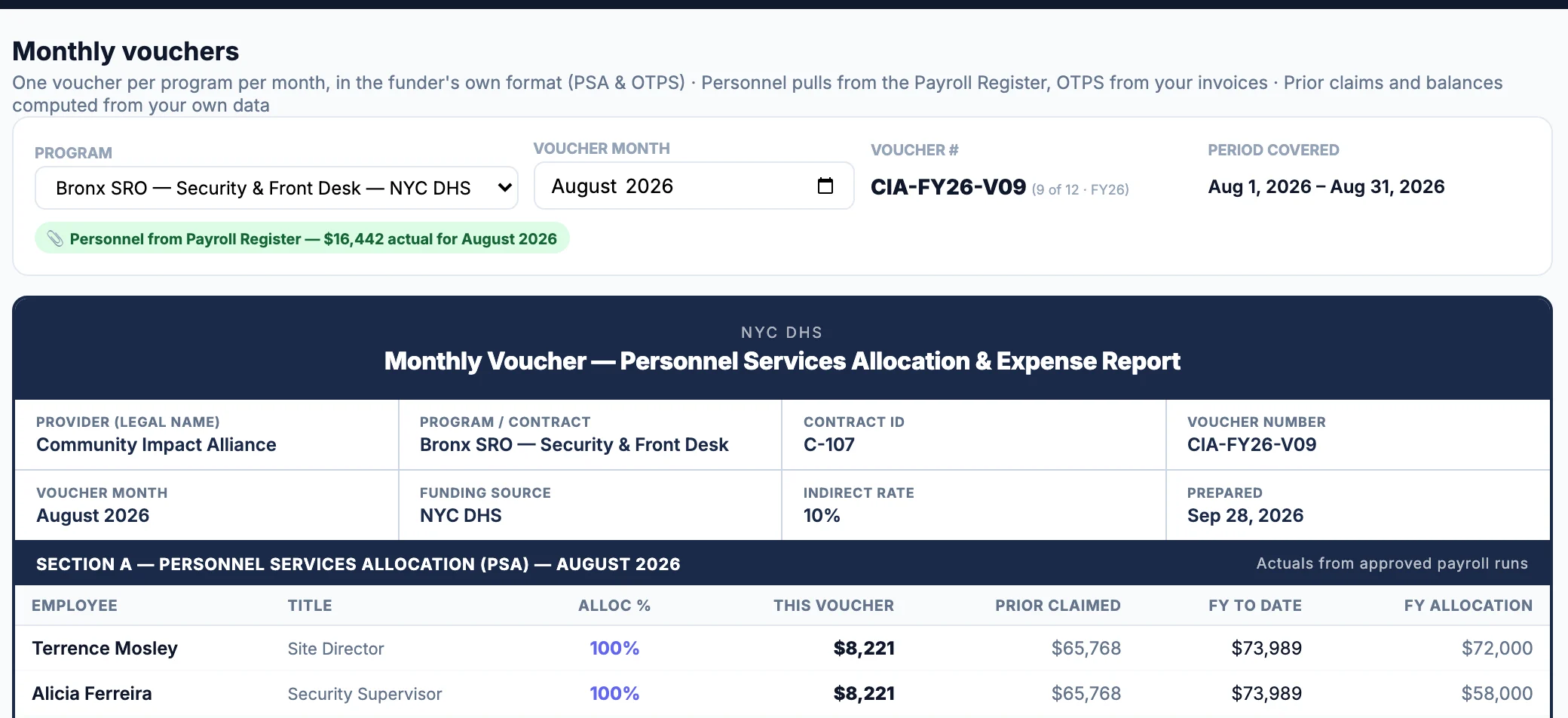
Prove It fills DHS's Monthly Expense Report — the funder's own template — and refuses rather than leave a row or a dollar off, but it is not yet a fixture-tested export: check it against the funder's form before you file. How support depth works →
Your DHS Monthly Expense Report, with the 10% de minimis DHS actually uses.
DHS's own March 2026 manual says 10% de minimis, not the federal 15% — most shelter contracts are city tax-levy funded — and maintenance work over $5,000 needs bids. Prove It builds the Monthly Expense Report from AI-read payroll and coded invoices with those rules already applied, and carries your facility details onto every report. You review every line before anything posts.
Plans by the number of awards and contracts you manage · View plans
What DHS checks before it pays
DHS uses a 10% de minimis
Most DHS shelter contracts are city tax-levy funded, so the federal 15% de minimis does not apply.
Maintenance work has a $5,000 bid threshold
Much lower than the $25,000 threshold for goods — it catches providers out regularly.
- OTPS goods over $25,000, or maintenance work over $5,000, require a minimum of three written bids; below those thresholds market research documentation suffices
- OTPS services over $25,000 require ACCO approval in PASSPort rather than competitive bids
- Third-party vendor agreements over $25,000 require DSS Agency Chief Contracting Officer approval
- Single Audit required if the organization expends $1,000,000 or more in federal awards in its fiscal year
- DHS's own March 2026 Fiscal Manual specifies no petty cash policy
What Prove It does about it
Imports payroll from ADP, Paychex, Gusto, Paylocity, TriNet, QuickBooks and anything else that exports a file. Common layouts are read instantly; anything else, Claude AI finds the names, gross pay and pay date. You confirm every name before anything posts.
- Download DHS Monthly Expense Report — DHS's monthly shelter-contract voucher covering personnel, fringe, OTPS and indirect, with facility address, program type, unit count and purchase order # from the setup card.
- Download voucher Excel (voucher number) — Four sheets — Voucher Summary, PSA (monthly), OTPS detail and Certification — laid out by this funder's own categories, from your approved payroll and coded invoices.
DHS identifiers
Facility Address, Program/Facility Type, Number of Units and Purchase Order # — entered once and carried onto every Monthly Expense Report.
Coded invoices flow into the OTPS detail: the month's expenses are auto-included in this voucher, you uncheck an item to hold it for a later voucher, and earlier-dated invoices count as prior claims automatically. Categories follow DHS's own list — Contracted Services, Social / Cultural Outings, Professional Services / Front Desk, Office Supplies, Consultant Costs.
The free voucher checker is a fixed set of rules, not AI: costs DHS's manual lists as unallowable, fringe above the 35% review threshold the app uses for DHS, allocations that don't total 100%, totals that don't reconcile, blank contract, provider or period identifiers — plus DHS's own recurring errors: DHS uses a 10% de minimis; Maintenance work has a $5,000 bid threshold. The file is read in your browser and never uploaded. Check a DHS voucher.
Ask a CFO answers "can I charge this?" from DHS's current fiscal manual, with the source and date cited. AI guidance grounded in your live platform data, 2 CFR 200, and live lookups of current funder manuals — not legal, tax, or audit advice. Confirm consequential decisions with your funder or auditor.
Every voucher Excel carries four sheets — Voucher Summary, PSA (monthly), OTPS detail and Certification — so the backup travels with the claim, and the Print / PDF view gives you the same voucher for a signature.
DHS at a glance
Free DHS resources
Your next DHS voucher, filled into DHS's own template
Try the live demo with sample data, then choose the plan that fits the number of awards and contracts you manage. Checkout is hosted by Stripe.
DHS questions
Why 10% and not the federal 15% de minimis?
DHS's own March 2026 manual states 10% — the most current MOCS-approved ICR, or 10% de minimis if applicable — because most DHS shelter contracts are city tax-levy funded, not federal. The app shows that basis on the voucher and the checker's DHS advisory repeats it.
What about repairs and maintenance?
Maintenance work has a $5,000 bid threshold under the DHS manual. The app doesn't collect bids for you; the checker's advisory and the OTPS coding are where you see the line before it goes out.
Which details does the report need from me?
Facility address, program or facility type, number of units and the purchase order number — once, on the DHS identifiers card. Payroll and invoices do the rest.
Does Prove It submit my DHS voucher for me?
No. Prove It builds the voucher and the backup from your live numbers; a person on your team reviews every line and submits it the way you do today. Nothing is filed automatically, and nothing guarantees acceptance — what you get is the funder's own template, filled from the same payroll and invoices you already have, with the recurring errors flagged — check it against the funder's form before you send it.
Other funders
New York City
New York State
Federal
Back to the Resource Center.